
Excellent hunting, haijin! You caught a variety of kigo! Congratulations to last week’s contributors:
Haikai Challenge Participants| 1. Ken Gierke / rivrvlogr 2. Dave Madden 3. Jules 4. Peter 5. joem18b | 6. Eugenia 7. Sangeetha 8. Pat R 9. Tessa Dean 10. Li/Lisa | 11. Janice 12. Linda Lee Lyberg 13. Kerfe Roig 14. Revived Writer |
Powered by… Mister Linky’s Magical Widgets.
Onward!
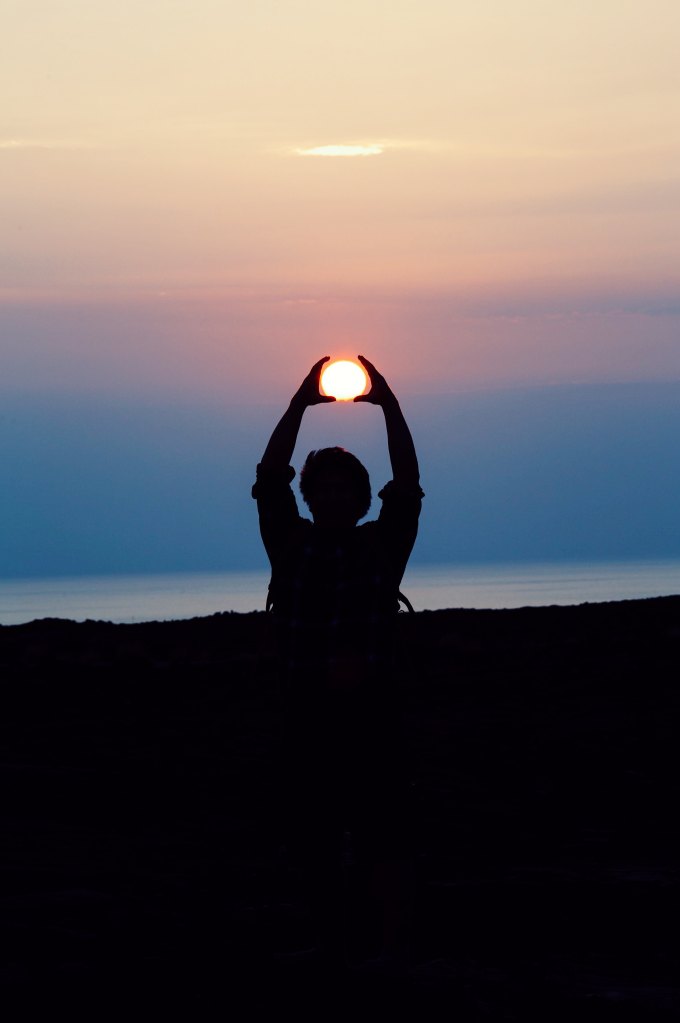
Today marks the first Solstice of the year:
A solstice is an event occurring when the Sun appears to reach its most northerly or southerly excursion relative to the celestial equator on the celestial sphere. Two solstices occur annually, around June 21 and December 21. In many countries, the seasons of the year are determined by reference to the solstices and the equinoxes.
The term solstice can also be used in a broader sense, as the day when this occurs. The day of a solstice in either hemisphere has either the most sunlight of the year (summer solstice) or the least sunlight of the year (winter solstice) for any place other than the Equator. Alternative terms, with no ambiguity as to which hemisphere is the context, are “June solstice” and “December solstice“, referring to the months in which they take place every year.[3]
“Solstice“, Wikipedia
As is typical for this crazy year, an annual solar eclipse follows hot on the first Solstice’s heels:
This weekend, stargazers in the Eastern Hemisphere will be treated to an annular solar eclipse on the heels of the summer solstice. This type of eclipse is characterized by its stunning “ring of fire” since it’s not a total eclipse and edges of the sun can still be seen around the moon.
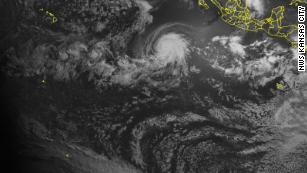
“Annular eclipses are similar to total eclipses in that the moon, Earth and sunare aligned so that the moon moves directly in front of the Sun as viewed from Earth,” said Alex Young, associate director for science in the heliophysics science division at NASA’s Goddard Space Flight Center.
Such Fun!
This week, write the haikai poem of your choice (haiku, senryu, haibun, tanka, haiga, renga, etc.) that alludes to the Solstice: (Summer or Winter), or Midsummer (manastsu) / Midwinter (mafuyu).
As always:
Here’s how the challenge works:
1. write the haikai poem of your choice.
2. post the link of your post to Mister Linky.
3. pingback by posting the link to the challenge on your site.
4. read and comment on other contributors’ posts.
Enjoy the solstice, haijin! If you live in the Eastern Hemisphere, have fun watching the ring of fire!


 Frank J. Tassone
Leave a comment