
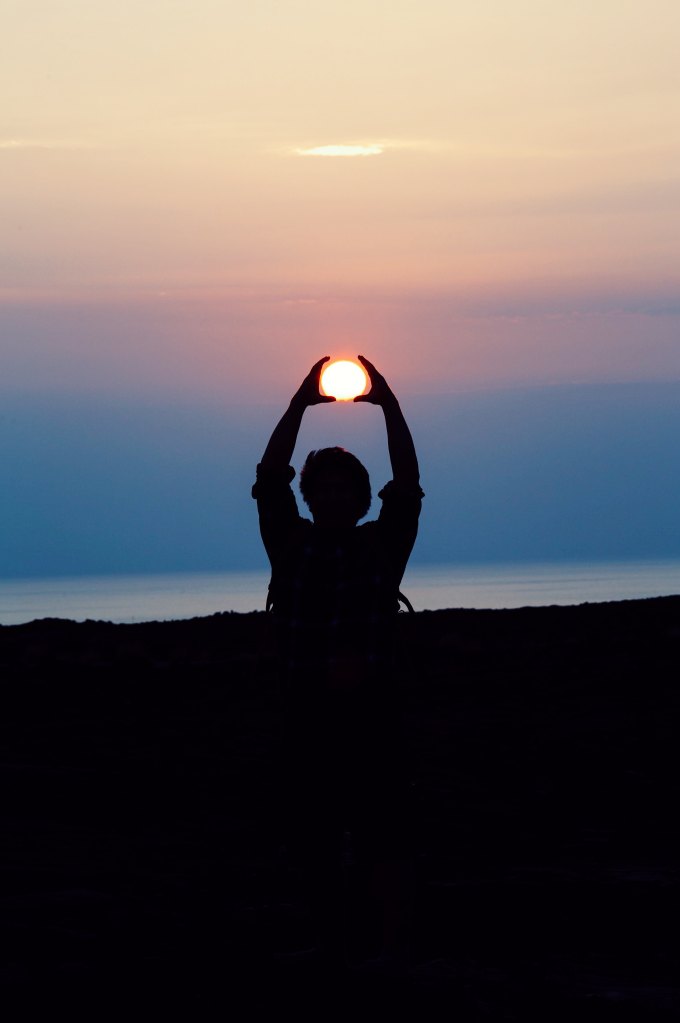
Since the mountain didn’t come to you, many of you went to it, haijin!
Congratulations to last week’s contributors:
Haikai Challenge Participants
| 1. Dwight L. Roth 2. Ken Gierke / rivrvlogr 3. Reena Saxena 4. Suzanne 5. Jane Dougherty | 6. Jules @ Strands 7. Jules @ Strands 8. Helene Vaillant 9. Janice 10. Pat R | 11. The Dark Netizen 12. rene hearthchild 13. Revived Writer 14. Xenia Tran |
Powered by… Mister Linky’s Magical Widgets.
Moving on:
Yes, you have seen that photograph before–in June! Well, now that December is halfway done, the last Solstice of 2018 will arrive in less than a week!
As I mentioned then, I say again:
No, I won’t tell you which one this week’s Solstice is: That depends on the hemisphere in which you live! As Wikipedia says:
A solstice is an event occurring when the Sun appears to reach its most northerly or southerly excursion relative to the celestial equator on the celestial sphere. Two solstices occur annually, around June 21 and December 21. The seasons of the year are determined by reference to both the solstices and the equinoxes.
The term solstice can also be used in a broader sense, as the day when this occurs. The day of a solstice in either hemisphere has either the most sunlight of the year (summer solstice) or the least sunlight of the year (winter solstice) for any place other than the Equator. Alternative terms, with no ambiguity as to which hemisphere is the context, are “June solstice” and “December solstice”, referring to the months in which they take place every year. [2]
At latitudes outside the tropics, the summer solstice marks the day when the Sun appears to reach its highest point in the sky. Within the tropics, the Sun appears directly overhead at solar noon days to 3 months before and after the summer solstice. This means the subsolar point occurs twice each year at any tropical latitude.
The word solstice is derived from the Latin sol (“sun”) and sistere (“to stand still”), because at the solstices, the Sun’s declination appears to “stand still”; that is, the seasonal movement of the Sun’s daily path (as seen from Earth) stops at a northern or southern limit before reversing direction.
This week, write the haikai poem of your choice (haiku, senryu, haibun, tanka, haiga, renga) that states or alludes to Solstice. You may use the solstice appropropriate to your locale or the term in general, as you see fit.
As always:
Here’s how the challenge works:
1. write the haikai poem of your choice.
2. post the link of your post to Mister Linky.
3. pingback by posting the link to the challenge on your site.
4. read and comment on other contributors’ posts.
Enjoy the official beginning for your coming season, haijin!


 Frank J. Tassone
Leave a reply to merrildsmith Cancel reply