
I trust you’ve savored the fragrance of the season, haijin? Some of you clearly did. Congratulations to last week’s contributors!
Haikai Challenge Participants| 1. Dwight L. Roth 2. Jane Dougherty 3. Reena Saxena 4. Jules 5. The Dark Netizen | 6. The Dark Netizen 7. Ken Gierke / rivrvlogr 8. Linda Lee Lyberg 9. Deborah 10. Tessa | 11. Janice 12. Xenia Tran 13. Revived Writer |
Powered by… Mister Linky’s Magical Widgets.
Ultreya!
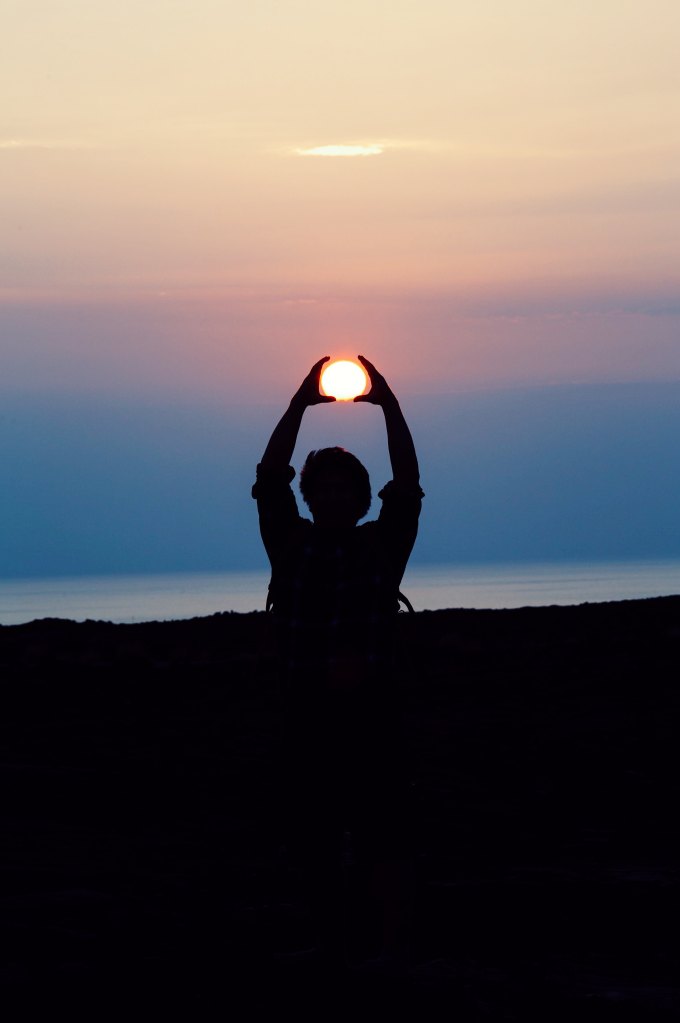
You’re not imagining it. This photo did, indeed, appear almost a year ago, for our kigo “Solstice.” It still suits our current interest, as this Friday, June 21st marks the first Solstice of the year:
A solstice is an event occurring when the Sun appears to reach its most northerly or southerly excursion relative to the celestial equator on the celestial sphere. Two solstices occur annually, around June 21 and December 21. The seasons of the year are determined by reference to both the solstices and the equinoxes.
The term solstice can also be used in a broader sense, as the day when this occurs. The day of a solstice in either hemisphere has either the most sunlight of the year (summer solstice) or the least sunlight of the year (winter solstice) for any place other than the Equator. Alternative terms, with no ambiguity as to which hemisphere is the context, are “June solstice” and “December solstice“, referring to the months in which they take place every year. [3]
The word solstice is derived from the Latin sol (“sun”) and sistere (“to stand still”), because at the solstices, the Sun’s declination appears to “stand still”; that is, the seasonal movement of the Sun’s daily path (as seen from Earth) stops at a northern or southern limit before reversing direction.
from the Solstice article, Wikipedia
According to the traditional calendar, this time of year is known either Midsummer (North of the Equator):
Midsummer is the period of time centered upon the summer solstice, and more specifically the northern European celebrations that accompany the actual solstice or take place on a day between June 19 and June 25 and the preceding evening. The exact dates vary between different cultures. The undivided Christian Churchdesignated June 24 as the feast day of the early Christian martyr St John the Baptist, and the observance of St John’s Day begins the evening before, known as St John’s Eve.
These are commemorated by many Christian denominations, such as the Roman Catholic Church, Lutheran Churches, and Anglican Communion.[1][7] In Swedenthe Midsummer is such an important festivity that there have been serious discussions to make the Midsummer’s Eve into the National Day of Sweden, instead of June 6. It may also be referred to as St. Hans Day.[8]
from the Midsummer article, Wikipedia
or Midwinter (South of the Equator):
The winter solstice (or hibernal solstice), also known as midwinter, occurs when one of the Earth’s poles has its maximum tilt away from the Sun. It happens twice yearly, once in each hemisphere (Northern and Southern). For that hemisphere, the winter solstice is the day with the shortest period of daylight and longest night of the year, when the Sun is at its lowest daily maximum elevation in the sky.[1] At the pole, there is continuous darkness or twilight around the winter solstice. Its opposite is the summer solstice.
The winter solstice occurs during the hemisphere’s winter. In the Northern Hemisphere, this is the December solstice (usually 21 or 22 December) and in the Southern Hemisphere, this is the June solstice (usually 20 or 21 June). Although the winter solstice itself lasts only a moment, the term sometimes refers to the day on which it occurs. Other names are “midwinter”, the “extreme of winter” (Dongzhi), or the “shortest day”. Traditionally, in many temperate regions, the winter solstice is seen as the middle of winter, but today in some countries and calendars, it is seen as the beginning of winter. In meteorology, winter is reckoned as beginning about three weeks before the winter solstice.[2]
Since prehistory, the winter solstice has been seen as a significant time of year in many cultures, and has been marked by festivals and rituals.[3] It marked the symbolic death and rebirth of the Sun.[4][5][6] The seasonal significance of the winter solstice is in the reversal of the gradual lengthening of nights and shortening of days.
from the Midwinter article, Wikipedia
And now that I have those captain obvious monologues out of the way, let’s unveil this week’s kigo. Write the haikai poem of your choice (haiku, senryu, haibun, tanka, haiga, renga, etc.) that alludes to your choice of either midsummer (manatsu) of midwinter (mafuyu). If you’re feeling particularly adventurous, write from the opposite perspective of the hemisphere in which you live (optional, of course)!
As always:
Here’s how the challenge works:
1. write the haikai poem of your choice.
2. post the link of your post to Mister Linky.
3. pingback by posting the link to the challenge on your site.
4. read and comment on other contributors’ posts.
Enjoy the longest day or night, haijin!


 Frank J. Tassone
Leave a comment